Showing posts with label gardens. Show all posts

Saturday, August 12, 2017

Gardening: Cautionary Tales: Unassuming Killers

Hello, Gardeners!

To continue our cautionary posts, we are going to be talking about plants you wouldn't think would take over your garden, but do.

There are two types of plants that can take over a vegetable garden: invasive plants and vining plants.

1) Invasive Plants
The giant green stuff is mint.
Invasive plants simply invade the area they are given and take over, pushing the other plants out in a variety of ways. The invasive plants you've probably heard the most about are weeds. However, we often keep invasive plants in our gardens as well. A few of these are strawberries, chives, mint, and oregano. Plants like these usually send out "runners," or baby plants (sometimes called daughter plants) under the soil. These runners are connected to the main roots. The runners then turn into regular plants, except for one thing: they are still connected to the main plant. (This reminds me of Larryboy and the Rumor Weed, a VeggieTales show. Here's a link to the whole thing. I couldn't find just the part I'm thinking about.) In any case, invasive plants usually do best in pots or somewhere where they are contained. And all the plants I listed are perennials as well, so you can't just start again next year. I should have listened to gardening advice before planting my mint and oregano. Oops.

2) Vining Plants
Vining plants are just that: any plant that vines. This would include members of the squash family, cucumber family, beans, peas, and a few others. (By the way, if beans and peas are labeled as the bush variety, that means they don't vine, so they're fine.) Vining plants always want to hold on to something. They also like holding on tight. Although this doesn't seem like it would be an issue, it becomes a problem when your vining plants begin to wrap around your other plants, or themselves. Beans hold on to other plants, but usually just enough so they'll be secure, but cucumbers will squeeze until they can't squeeze anymore, which can cut off circulation of that part of the vine or plant, causing it to die. (This is based on personal experience, so your plants may act slightly different.) Often, only parts of vines or parts of plants die, so it probably won't kill the whole plant.

Obviously, people still grow these plants, and we don't want to be able to only grow one type of plant for the rest of our lives. So, what do we do?

Answer: Work.

Solutions:

Invasive Plants:
I kind of already mentioned this, but try to grow invasive plants in their own containers. You can also just weed a lot. I don't mean weed the weeds, I mean pull up the daughter plants if they're getting too out of hand.

Vining Plants:
Untangle. Every few days, go out and gently untangle the vines. If the vines don't seem to be impeding a plant's space or squeezing too tight, sometimes it's easier just to leave it. For example, last year, I had beans growing near garlic, and the beans wrapped around the garlic leaves. Because the
beans were just loosely wrapped around, and the garlic still grew fine, I just left it. However, if you notice a vining plant is squeezing, you need to gently untangle that vine, otherwise it'll end up killing the part of the plant it's squeezing. Depending on the type of vining plant, you may need a trellis or something it can climb. This will help direct the plant's growth. You should still check the vining plant regularly and redirect its tendrils if need be.

Have you ever had problems with these types of plants
?

Spruce Nogard

Saturday, July 15, 2017

Gardening: Cautionary Tales: Soil

Good Day, Gardeners!

Today, we will be talking about soil. Why talk about such a boring topic? First of all, it's not boring. It's interesting. Second of all, because this is useful and important information.

Now, I have four main cautionary points to talk about.

1) Beware! Non-organic Fertilizers
Although you may not know it, a lot of soils actually contain artificial fertilizers, which are not good. I shall have to have a whole post about fertilizer sometime. Anyways, fertilizers often give plants a boost, but using chemicals. I don't know about you, but I wouldn't prefer eating chemicals with my food, especially when studies have shown they have less-than-desired side effects.

2) The Shocking Truth: The Diet of Vegetables
Not all soil is okay for vegetables to grow in, because soil used for flowers sometimes contains chemicals that are even worse for humans to eat. As long as you know the soil in your backyard hasn't been used as a toxic waste dump or anything, you should be fine. This is more for buying bags of soil at the store. Be sure to check the back!

3) Danger Ahead! Direct Contact with Soil
At the store, some bags of soil, although fine to grow vegetables in, have tons of warnings about how to always wear gloves when coming into contact with the soil, and always wash your hands afterwards, and never touch your face. . . If you have pets or children, then you should probably be wary of this type of soil. Also, when you think about it, if a vegetable ends up resting on the dirt, is it okay to eat it, even though you rinsed it? I mean, you were supposed to wash your hands whenever you touched the soil. . . However, I have found bags of soil that are certified and promise they are "clean." This means the organic fertilizers they use are safe to touch, and safe for children and pets to be around. (You can use the less expensive soil, you just have to be careful.)

4) A Word of Warning: The Relationship Between Tomatoes and Manure
In short, tomatoes grow really giant and huge in manure, which is great, until you realize none of your tomatoes are turning red. So, don't grow tomatoes in manure. :)

So, here's our (somewhat devious) gardening post for today!
Spruce Nogard
Attributions: https://pixabay.com/en/caution-sign-safety-warning-risk-454360/

Saturday, June 17, 2017

Gardening: Heirloom Tomatoes vs. Regular Tomatoes*

Hello, Gardeners!

Today, I'm going to explain some stuff about heirloom tomatoes and regular tomatoes. As I've not gardened a ton in my life, this is a more basic overview, so if you want specific information, you can look that up separately. Also, if you are planning on planting a specific type of tomato, RESEARCH THAT  INDIVIDUAL TOMATO FIRST. Do NOT rely on this post for specific information.

Now, on to tomatoes.

Heirloom Tomatoes:

Pros:
Heirloom tomatoes are older tomato varieties. They have been around for a long time, and have not been changed by genetic engineering, or science. These tomatoes often have superior flavor, and you can trace their origins. Also, it's easier to find organic seeds of heirloom tomatoes.

Cons:
Heirloom tomatoes, because they aren't changed to resist genetic disorders or pests, are more prone to genetic issues or pests. They also are more fragile because they have not been "toughened up" by humans.


Regular Tomatoes:

Pros:
Regular tomatoes are easier to take care of because of science. Basically, many regular tomatoes are bred and engineered to be more resistant to genetic disorders and pests.

Cons:
Regular tomatoes often don't have as good of a taste, but any homegrown tomato is going to taste ten times better than grocery store tomatoes. :) Also, it's harder to find organic seeds, and if the regular tomato is labeled "hybrid," you can't harvest the seeds to replant next year.

I hope you found this helpful!

Spruce Nogard

*Post actually written on June 25th. See here for details.

Monday, May 22, 2017

On My Mind: My Dream House*

Hello, Dreamers.

Today, I was wondering what your dream house would be like. Even though it's quite unrealistic, imagine what the perfect house (on Earth--we'll save fantasy/dystopian, etc. houses for later) would be.

Mine would have some main parts:

1) Library. I would have a library room, and tons of cats. Some relatives of mine have a library room, and it is one of the most magical places ever. Also, their four cats make the room complete. :)

I always imagine the giant libraries, like in both the Beauty and the Beast movies. Wouldn't it be fun to have that many books?

2) Garden. I would have a giant vegetable garden. Because my dream garden is so big, (and perhaps not doable), I'll have to give it its own post.

3) Cat rooms. I would foster cats, and of course, have my own. I'd have to make sure they all had plenty of space.

4) A cellar, or someplace to hang herbs, and a very big freezer.

5) A few bedrooms, a good-sized kitchen, dining room, and at least one family room.

What does your dream house look like?

Spruce Nogard
*Actually posted on May 31st. See here for details.

Attributions:

Saturday, May 13, 2017

Gardening: Sprouts and Runners*

Hello, Friends!

It's good to be writing again!

Today, I just wanted to share a few things that are happening in my (small) garden this year.

1) Sprouts

A few neglected bean pods from last year actually sprouted! They're very cute. :)

2) Runners

As many of you know, mint will take over your garden. I knew this, and didn't plant mint in a pot anyways. Sigh. Surprisingly, though, this year, my oregano did the same. After being a baby plant last year, it started taking over the garden. It also looks very similar to mint. . . and when I looked it up, I discovered they're from the same family. Hurrah! (Or not.)

Can you tell which one's mint and which one's oregano?


How are your gardens doing?

Spruce Nogard

*Even though this post says it was written on May 13th, it was really written on May 31st. I change the dates to what they should be if the post was written on time to keep my records straight. It is not a glitch your browser or my blog has.

Saturday, April 15, 2017

Gardening: The Cycle. . . Does Not Begin Again

Hello, Gardeners.

Unfortunately for me this year, I will not be able to garden. Thankfully, this is due to a wonderful opportunity I am blessed to have, but it will be a little sad not to garden.
Herbs

Beans (Some herbs on left side), Also where I had my garlic

Tomatoes

Usually, right now, I would have started seeds, hoping for my little baby tomatoes and cucumbers and beans to grow big and strong and healthy.

Instead, however, I am enjoying the unusually warm weather, and beginning to smell spring in the air.

What are your favorite parts about spring?

Spruce Nogard

Saturday, March 11, 2017

Gardening: What do You Prefer?

Hello, Friends!

Sorry this post is up late. (I'm writing it on Monday, despite what the top says.)


Do you prefer:

Flower gardens or vegetable gardens?

Fruits or vegetables?

Shade plants or sun plants?

Starting from seed or starting from seedling?


Spruce Nogard


Saturday, February 11, 2017

Gardening: Nifty Trick: Blossom End Rot and Epsom Salt

Hello, Friends!

If you are looking on most people's bright side, it is almost spring! (Or you can pretend it is.) I actually get kind of sad around spring. I wish it was winter, with the crisp air, snow, and. . . well, I'm not exactly sure why.

Back to today's topic, though: Epsom Salt.

Have you ever heard of blossom end rot? It happens to a few plants, but the one I've had experience with is tomatoes.

Blossom end rot is when the blossom end of a tomato turns black and mushy, which can be a result of magnesium or calcium deficiency, according to sfgate.com. Thankfully, however, blossom end rot is not caused by pests. Yay!

An easy fix to blossom end rot is by applying Epsom Salts. (The kind you use for feet baths, etc.)

Just apply one tablespoon around the base of the plant when it first appears, or if you know your soil is lacking these nutrients, and maybe once more if needed. And that's it!

Do be careful, though, because Epsom salt can leak into water sources, so don't use too much of it, or use it for a long time.

Sorry, I couldn't find pictures of tomatoes with blossom end rot or Epsom salts for free, and I don't know where my pictures (if I took any) are.

Source: http://homeguides.sfgate.com/epsom-salt-tomato-plant-blossom-rot-58658.html

Saturday, January 14, 2017

Gardening: Organic Gardening

Hello, Gardeners!

You might be wondering how I'm going to post about gardening if I can't have a garden in winter. You'll see. . .

Anyways, this should be interesting, because Dragomir is here to add his views to it. (I didn't know he gardened until yesterday.)

Today, I am talking about organic gardening.

Why should you garden organically?

1) Pesticides

Many plants at grocery stores are covered in pesticides, or in pesticide residue. Pesticides are used to kill pests, so it makes sense fruits and veggies would be covered in them.

There are plenty of studies showing the effects of pesticides. However, few studies have been done long-term on humans with pesticides ingested through food. Even if you wash your fruits, greens, and veggies, some of the pesticides still remain. Laws limit the amount of pesticides allowed to be used on plants intended for eating, but still, the purpose of pesticides is to kill pests. If something's sole purpose is to kill, how bad is the build-up of pesticides in our bodies?

Now, I am not trying to implant in your brains a fear of food from the grocery store, but I do think it's better to eat organic.

Dear Readers, I do believe she is trying to impress upon you the good and right fear of food acquired at the grocery store. The only way to stay safe from this impending threat is to avoid it utterly.

And that is the extreme version of what I was trying to say.

3) GMOs

GMO: Genetically Modified Organism

As Mrs. Seleshanko clarifies in her profound work entitled: Grow the Dirty Dozen, some produce and or packaged food is engineered using Genetically Modified Organisms. Furthermore, Mrs.
Seleshanko notes that an assortment of Genetically Modified Organisms are made using "genetic material from soil bacteria. . . [or] insects." That, as we must all agree, is unquestionably repugnant.

2) The Cost of Gardening Organically as Compared to the Cost of Buying Organically or Buying Non-Organic Food

As one celebrated quote proclaims: "When I get a little money I buy books, and if I have any left I buy food and clothes." -Erasmus
Although this is not, in any sense, practical, I presume that you, dear Readers, would realize the truth of this quote. As implied, gardening in the organic sense is considerably more affordable. This would cause one to conjecture, thereafter, that one would attain a larger budget for books.

If you buy a packet of organic seeds for about $3.50, and get maybe 20-100 seeds, and about half of them come up, you are saving much more money than even getting a seedling for the same amount of money. Not to mention, you are saving much more than getting a couple of the fruit/vegetables at the grocery store. Not to mention, (again) that organic foods are much more expensive than non-organic foods. And, yes, as Dragomir mentioned, this means you have more money for books.

And that is why you should garden organic, Friends!

Spruce Nogard
Dragomir Volkov

Attributions:

Saturday, December 10, 2016

Gardening: Rhubarb

Hello, Friends!

I'm sorry this post is up late. I know I've been saying that a lot, but I have finals and everything is crazy, so I really might be behind on posts for a while. After the next week and a half, though, I'll be able to keep up better. I'll also write longer and less hurried posts. :) Sorry!

Today, we are talking about rhubarb. You can find how to grow rhubarb anywhere by just searching it, so I'm not going to repeat what everyone else already said. That would be useless, as well as boring.

Anyways, I am going to share three fun facts about rhubarb.

First of all, did you know rhubarb actually needs the cold to be perennial?

A lot of the time, it seems like people think the cold is useless, a pain, or just plain miserable. If you live in a place that gets snow, the roads are really slippery, traffic is backed up, and everyone is afraid they'll get stuck, or slide or break down. . . But then, there are some people, sometimes, who love the snow. I am one of those people. Snow is part of the Christmas season, and somehow brings joy to people. I think it's also important that we realize that snow exists for a reason, just like everything else. In this case, it gives us rhubarb cakes, strawberry-rhubarb pie. . . I'm not saying there isn't a downside to snow. Traffic does get bad, it's harder to drive, and all of that, but still, it's snow.

Also, I have rhubarb that was part of a one-hundred year old plant. Isn't that crazy?

When we think about Christmas, we think about Jesus and how he came 2,000 years ago. How different it must have been back then. Then you think about these century old plants and how much they must have seen in their lifetime. How many animals scurried among them? How many people used their produce? How did people care for them?


Finally, rhubarb leaves are poisonous.

We often don't realize it, do we? How so many things have a good side and a bad side. Rhubarb stalks taste wonderful, but their leaves are poisonous. Snow is beautiful, and brings us joy, but also is dangerous to drive in, and cold.

We live in a strange world. Strange plants exist. Snow is wonder-full, but dangerous.

Have a beautiful Christmas season, Friends.

Attributions:
https://pixabay.com/en/rhubarb-plant-garden-rhubarb-1406455/
https://pixabay.com/en/winter-landscape-snow-cold-wintry-22506/ 

Saturday, November 12, 2016

Gardening: We All Learn

Good Day, Gardeners.

First, just to make it clear, you all know I'm a bit peculiar, right? Good.

Our post today is about how gardeners have to have a balanced relationship with their plants. Am I personifying plants a little? That depends on your perspective. Is that a not normal thing to do? Yes. But, you don't mind, do you? After all, you are reading my blog. :)

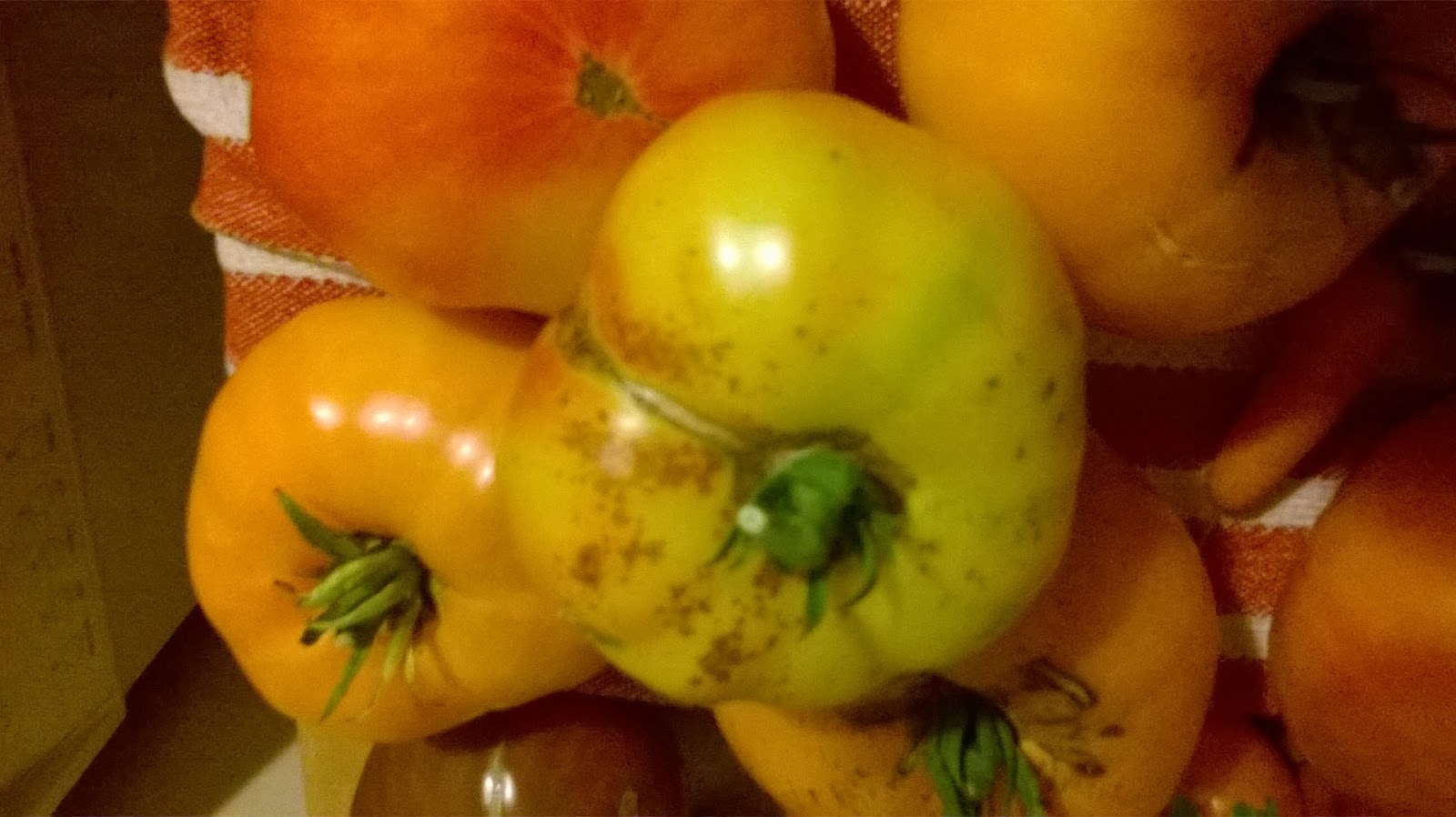
As you can (or can't--I'll be adding pictures soon) see, I brought in all my tomatoes from out-of-doors today. They are organized into three categories: Amana Orange tomatoes, German Striped Tomatoes and tomatoes that need to be either cut up right away or watched carefully. Altogether, there are [#].

Now, unfortunately, I was unable to get pictures before dark tonight, so I am unable to show you pictures of my gardens. They look really dead, neglected, and forlorn at this point.

My cucumbers got blight, and my squash didn't produce any squash--for that matter, they didn't produce any female flowers. Besides once when I was little, whenever I've tried to grow squash, I haven't gotten any. Anyways, later, it got powdery mildew. It's a little sad.

Both the cucumbers and squash died.

My herbs are still doing wonderfully, and although I did not get as many tomatoes as last year, I still got a fair number.

(You may be wondering where the plant personification is. Don't worry. It's coming.)

The title of this post is "We All Learn." So, what does this have to do with learning?

As gardeners, we must learn from our mistakes. This year, I learned I did not balance my trust the plants can grow up, survive and live happy and healthy lives alone with their need for some Tender Loving Care. I know the plants can survive without human intervention, but do they have the best quality of life that way? I don't believe so. I neglected watering them, which led to an inconsistent amount of water intake, causing splitting/cracking. As long as you make sure to cut around the cracks and make sure the tomato isn't infected, they should be fine to eat, but don't take my word for it. :)

Remember, though, it doesn't mean you're a terrible gardener if you did neglect your plants. :) Everyone makes mistakes. Plus, it's good not to be too concerned about them, because plants do get sick, die, and have other problems, which we don't want you to stress a ton about.

Another thing I did is I got heirloom seeds. The main reason I did this is because it's much easier to find organic, non-gmo heirloom seeds than regular tomato seeds. (I'll talk about why I use all-organic everything in another post.) I had no clue heirloom and regular seeds were any different. However, heirloom tomatoes are older, so they aren't specifically bred to resist disease, or have few birth defects, like today's tomatoes are. By the way, if you want to grow heirloom tomatoes, I'm not saying you shouldn't. They taste absolutely amazing. However, if you are a first-time gardener, it would be easier for you to do regular tomatoes; in other words, tomatoes not labeled as "heirloom."

Heirloom tomatoes need more TLC than regular tomatoes, but, your whole garden needs tons of TLC anyways. Weed, pick veggies, and research out-of-the-ordinary occurrences regularly. I also did not do this consistently. :)

But, however your garden turned out, be happy with it!

And, show your plants how much you love them by rocking your tomatoes back and forth like babies!

Spruce Nogard

Saturday, October 15, 2016

Gardening: Not Yet Done

Hello, Gardeners!

Surprisingly, my gardens are still green. I've had a few more things, but not many. Also, I have four

Unfortunately, I did not make this beautiful pie. :)
little cucumbers on the vine. My herbs are doing wonderfully. It's fall, and that starts me thinking of fall recipes. Pumpkin pie, sweet potatoes, squash, beautiful colors of yellow, orange, and red. When I have a bigger yard, I would love to have pumpkin and squash in my garden as well.

What are some plants you wish to have in your garden but can't?

What are your favorite fall foods?


Spruce Nogard
Attributions:

Saturday, September 24, 2016

Gardening: Coming Toward the End

Hello, Gardeners.

Sorry this post is up late.

I live in Minnesota, so Autumn is starting to come. This means my gardens are starting to die. That's fine, though.

(If your wondering how I'm going to write about gardening without gardens, come back in two months. :) )

I'll probably have a few more things coming in over the next few weeks, so I'll give grand totals next month.

These are just totals so far:

3 cucumbers. They were in a lot of shade, so that makes sense.

My zucchini didn't have any fruit, for whatever reason.

8 garlic bulbs

41 carrots of various sizes

109 green beans

15 Amana Orange Tomatoes

13 German Striped Tomatoes

3 Cherokee Purple Tomatoes

Herbs!!!!!!

I will put pictures up as soon as I can. I can't really right now. :)

How are your gardens doing? Post below!

Spruce Nogard