Monday, June 13, 2016

Books: Favorites: The Invention of Hugo Cabret

Come, Friends. Come hear about one of the wonderful books of the world.

The Invention of Hugo Cabret, by Brian Selznick, is an amazing book.

The Invention of Hugo Cabret is about a boy who lives in a train station in Paris, in 1931. He runs the clocks in the train station, and has a journal full of interesting drawings. As we follow Hugo, we meet Isabelle, a girl who loves to read, and an old man who runs a toy booth. There is a slight hint of mystery to the book, but it is not an absolute mystery novel. The book is told through words and pictures; if you skip the pictures you miss part of the story.

What I love about the book is that it is told in words and pictures. I haven't read any other book told in both words and pictures. I have read books only in pictures, and of course, only in words, but never in both. The story was also amazing.

 I love this book. Have you, Friends, read it? Do you like it? What do you like about it?

Spruce Nogard

Source:

Attributions:

Saturday, June 11, 2016

Gardening: Small Start

Wonderful Weather, my Fine Friends!

Today, we will take another glimpse at my gardens, and if you want, you can share yours in the comments.

It is only the beginning of June, so where I live, plants are just getting started. I prefer to start my plants from seed, for various reasons. I'll have to write about that some other time. However, I do make exceptions, as most of my herbs I got as plants from the store.

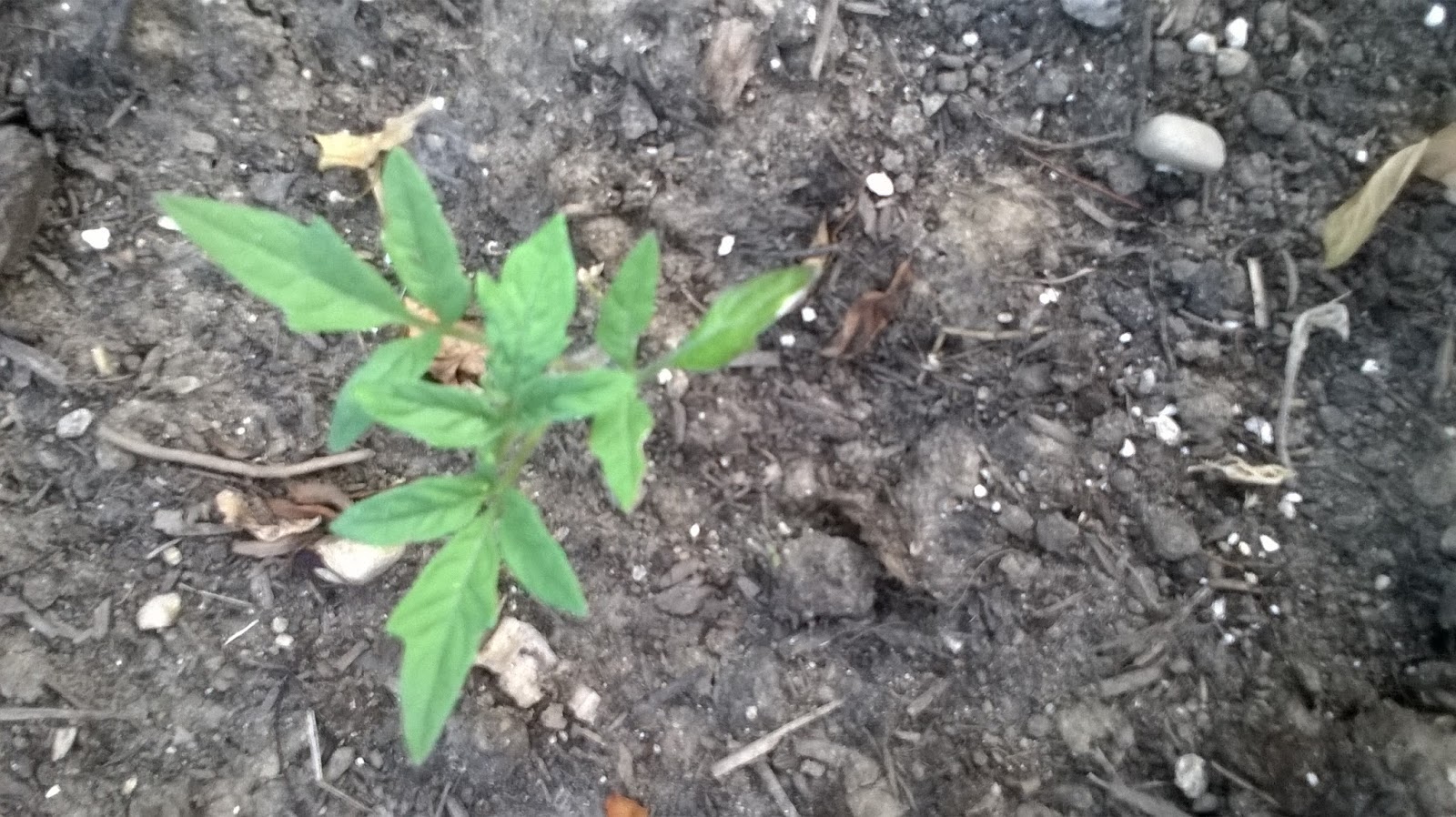
My veggies, (particularly my tomatoes), so far, are very small. This is perfectly fine with me, however. As you can see, my tomatoes are two to three inches tall and look like they will never grow. They are off to a small start.


My tomatoes in proportion to the rest of the bed (circled)

(By the way the chicken wire is to keep animals out of my gardens.)

Like many things in life, when things start small, it's hard to trust that they will grow, becoming something bigger and better. Last year, when I first started gardening, my tomatoes started off the same size as the ones this year. It would have been easy for me to give up. After all, how could something that small ever produce something as big as a tomato?

Last year, though, we had about 400 tomatoes from five tomato plants. I started them all from seed.

Last Year's Tomatoes--in the same size bed

By the way, this picture was taken about half- to three quarters-of the way through the summer--the plants don't have any red tomatoes yet, but if you look closely, you can see very big green ones.

Anyways. . .

In today's age, we want to be able to predict everything. We order things online, asking: When will my sister's present arrive? When will my new book get here? And we get answers. Fourteen days. Five days. If you become a member, two days.

We plan everything, from what we're doing this summer to what we eat. But some things can't be planned. They're not predictable. They don't follow a pattern. Those things, though, are just as important in our lives.

So, how do you know the barely three-inch seedlings that haven't grown for two weeks will survive?

You don't.

Sometimes, you just have to trust.

Spruce Nogard

Wednesday, June 8, 2016

Creative Complex: If and Only If

Hello, Friends!

Here is a fun activity that can take as few as thirty seconds. Unlike usual, you can just think of it in your head, instead of feeling like you have to write it down.

Here is the activity:

                        ,                                            if and only if                                                 .

The first blank should be a character. The second blank should be an action. The third blank should be a condition.

Here are some examples:

Cinderella, you can go to the ball if and only if you pick one bowl of lentils out of the ashes in one hour.


Daughter, you can marry your love, a commoner, if and only if you go to the four corners of the earth and bring me a feather from the right wing of each of the four winds.

Have fun! Leave a comment, creative and/or silly, of what you came up with below!

Spruce Nogard

Attributions: 

Monday, June 6, 2016

Recipes: Strawberry-Rhubarb Pie

Hello, Pie-Lovers!


Here is a recipe for a simpler version of strawberry-rhubarb pie. We always used to have strawberry-rhubarb pie when I was young, and it is one of my favorites. Here is a recipe from http://allrecipes.com/recipe/12612/rhubarb-and-strawberry-pie/

Ingredients:


Directions:

  1. Preheat oven to 400 degrees F (200 degrees C).
  2. In a large bowl, mix flour and sugar. Add strawberries and chopped rhubarb. Toss with sugar and flour and let stand for 30 minutes.
  3. Pour filling into pie crust. Dot top with butter, and cover with top crust. Seal edges of top and bottom crust with water.
  4. Apply yolk to top of pie, using a pastry brush. Sprinkle with sugar. Cut small holes in top to let steam escape.
  5. Bake at 400 degrees F (200 degrees C), for 35 to 40 minutes, or until bubbly and brown. Cool on rack.

Friday, June 3, 2016

Writing: Fairy Tales: Fairy tale Twists

Hello, Fantastical Creatures,

Today, we are talking about fairy tale "twists." At least, I like to call them twists. A fairy tale twist is where someone takes a classic fairy tale and changes a few things, but keeps the original story, to make it different. Examples of these are: Princess of the Midnight Ball by Jessica Day George, The Lunar Chronicles by Marissa Meyer, and many others. Princess of the Midnight Ball is a twist on "The Twelve Dancing Princesses." Cinder, the first in The Lunar Chronicles, is a twist on Cinderella. What fairy tale twists have you read?

Spruce Nogard

Attributions:

Wednesday, June 1, 2016

Creative Complex: Monster

Good Day, Friends!

Tonight, as you are laying in bed, you hear a sinister scratching coming from your closet. What happens next?
This prompt reminds me of a Veggietales song. Veggietales is a show for younger kids teaching them morals. It is Christian, but the song fits very well with this prompt. :)
Spruce Nogard
Attributions: 

Monday, May 30, 2016

Writing: Mental Library: Lit. Devices

Good morning/afternoon/evening to my fantastic, fabulous, Friends!

Today, we are adding another topic to our mental libraries: lit. devices/figurative language. Many of you have probably heard of these, and are maybe thinking: Oh, great. Not this again. After all, it is drilled into you in school. You might even wonder why they make any difference in writing. Here is an example:

Original sentence: She was hot.

Sentence with lit. devices: The girl felt like every bone in her body was on fire as her many muscles screamed for her mind to make her misery end.

See? It does make a difference after all.

Today, lucky Friends, we have a guest doing your post (the rest of it, anyways)! He is our first guest, and he writes Gothic stories. I mean, if you look up the definition of Gothic literature, that's what he writes. So, without further ado, let me welcome Dragomir Volkov!

Dragomir: Greetings, Readers. I am honored to be requested to post on Spruce's blog. As I do not have much time, I am unable to go into as much depth with each literary device as I otherwise would prefer. Notwithstanding this minor difficulty, I will endeavor to provide you with the primary elements of some select literary devices.

Alliteration: Alliteration is when many words start with the same sound in a sentence/phrase.


Example: The Headless Hunt grew hugely, year after horrible year.

Simile: A comparison between two or more unrelated things using like or as.

Example: The Headless Hunt's pandemonium was like the laughter of the sky.

Metaphor: A comparison between two or more unrelated things using is or are.

Example: The Headless Hunt's pandemonium was the laughter of the sky.

Personification: Giving human-like qualities to a non-human thing.

 Example: The forest's dead hands clawed despairingly at the ghostly glamour of the Headless Hunt's steeds.

Onomatopoeia: Words that describe a sound.

Example: The trees creaked as the Headless Hunt whooshed over them menacingly.

These are among the few basic literary devices one would find in literature. However, there are more I wish to explain, but Spruce has forbidden me to improve upon this post, considering it would then be too long, and of no interest to you. Farewell, Readers.

Thank you so much, Dragomir! We hope to have you back sometime soon! Among the lit. devices Dragomir didn't cover are: foreshadowing, irony, oxymoron, and many more. We shall have to post about them a different time.

Use your new knowledge of lit. devices in your future writing, Friends!

Spruce Nogard